“If you go slowly enough, six or seven months is an eternity—if you let it be—if you forget old things, and learn new ones. Even a week can last forever.”
Rick Bass, Winter

"In the midst of winter, I finally learned that there was in me an invincible summer."
Albert Camus

Showing posts with label dogs. Show all posts

Saturday, August 11, 2012

Part II, Day 72: Good Grief

It's been five weeks and two days since Zoe died.  I bought a book about pet bereavement, but I haven't had a chance to read it yet.  In a culture that still doesn't quite know how to talk about death, entering this landscape of grief is another new place for me, another new country, although a lot of friends have given me advice.

And not one person has implied I should get over it, and move on, even though I heard recently that grief is going to be listed as a pathology in the new DSM-5 coming out in 2013, that is, the fifth edition of the Diagnostic and Statistical Manual of Mental Disorders.  Apparently grief becomes pathological when it goes on a little too long.  I think you're allowed six months to a year to mourn, and then you get cut off.  After that, you need counseling, or drugs, or both.  I don't know the limit for pet bereavement.  If dogs live a seventh of our lifespans, does that mean we can only give them a seventh of the time we're granted for human family members?  If that's the case, I'm already close to tapped out. 

So here is my question:  How is healthy, non-pathological grief for one's dog supposed to look and feel?  I don't know.  All I can say is that the best advice I got from friends who have lost their beloved pups this year was to cry whenever I felt like it, for however long, and not to stop myself, not to judge myself, but to just let things be what they are.

It was the same advice I got when my mother died five years ago and when my best friend died suddenly when we were both only twenty-four.  The essence is: have your experience, and don't judge it.  Just be present.  Let what is come inside the house; abide with it without fear.  Grief delayed or repressed comes back later to haunt you anyway, so it's better to let it flow.  And so I've had to give up wearing mascara for a while.  It's liberating to live free of restraint, so open and unguarded, but I never know what to expect. 

Which is kind of what this dog has taught me ever since I brought her home, with one major difference.  In the 10 months after her diagnosis, I tried to be present with her always, to seize every day, to embrace the unexpected just as we made our routines feel new, but I also did my best not to cry in front of her or let her know when I was sad.  Now, I just move from laughter to tears to calm conversation to my eyes filling mid-word.  Living so fluidly--literally--is my new normal.  There were entire years in my life before this when I never cried once, not even at sad movies, and I would never cry in front of anyone, not even my loved ones.  It's hard to imagine now what that life was like.  It feels like it happened to someone else.

photo by Suzan McDermott, Bravura Photography
So if you ask me to describe how things are going around here, I can only tell you this: I am terribly sad sometimes, but I'm not despondent, and definitely not depressed.  And I can't really say I'm unhappy.  I sleep and eat, I exercise regularly, I'm back in yoga class, I water the plants, and I come as close to balancing my checkbook as I ever have.  I am still inspired by my work, extremely focused about it, and more in love than ever with my husband, family, friends.  I often feel great inexplicable surges of joy.  I hug my colleagues when I see them shopping at the farmer's market or checking on their book orders at the campus bookstore.  Sometimes my heart feels so full it almost hurts.  I feel gratitude for every sweet thing in my life, including the kindness of the gentle readers who followed this blog.  But I really miss my dog.  I miss my dog more as time goes on, not less, because at first it didn't seem so final, even though I saw her take her last breath. 

At first I thought I could be a Miss Havisham if I totally let myself go.  Instead of being the jilted bride who lives in her torn, stained wedding gown, with mold and cobwebs the only organic matter left in that room where the wedding feast would have occurred, I just thought I'd creep around with a lot of black Zoe hairballs in the corner.  I didn't want to vacuum up her fur, and when I did, I didn't want to throw it out, but I did anyway.  There's still a clump of it in our bedroom on the floor beneath all our sweaters.  Her toys are still in a box by the wood stove.  Our TV in the bedroom is still balanced on her crate, although my husband is making a new wooden stand and when that happens, the crate will get broken down and will live in the room where we keep our suitcases.  I also have a little portable Zoe shrine I bring to the deck sometimes when I meditate.  It has her collar with the purple heart for bravery that was given to her by her oncologist, a sand dollar I found when we were walking on the beach at Topsail Island this past March, and a completely disemboweled red fleece bow she got under the tree one year that she used to balance on her nose and still smells like her.

I sit out on the deck with this odd collection and imagine her looking at me as she did in this photo on an ordinary morning in the last couple weeks of her extraordinary life.

Maybe she would think Mommy was acting a bit strange if she saw me sniffing her eviscerated toy or jangling her collar, trying to recreate the sound of her running up to me.


I did this every day from the day she died until about two weeks ago.

Now I do it about once a week.

I wish I could see her, even just out of the corner of my eye, but my mind refuses to play tricks on me.  This is what frustrates me the most.  Being with Zoe for nine years grounded me, made me more present in the here and now, more planted on this earth, less likely to retreat to my space girl imagination.  But sometimes I wish my imagination would help me out.  I used to be a lot more other-worldly.  If I could believe now in another dimension, that a spirit world was right around us, I would allow myself to think she was still with me here, sitting on my left, as friends of mine who think that way promise me she is. 

But even though I don't believe she's here, I talk to her.  When I get in the car, I tell Zoe she's a good girl and I'll picture her smudging up the window with her nose.  (I have cleaned my car twice since she died, and vacuumed up her fur, but have yet to wash off those doggy nose smears.)

I talk to her a lot in my studio, since she spent so much time here with me and I wrote almost all of my posts here with her looking right at me.  I'll just say that she's a great girl, a beautiful dog, that she's so good, that she's so good, so very good.

And sometimes I just smile and say, Hi, baby dog, and I'm flooded with the memory of her essence, and I feel peace.  I see her grinning at me just like she did in this picture below:


Kelly Prime took this photo of Zoe looking at me, May of 2012.  The poop bag got in the picture too.

My former student took this photo of Zoe and me on an ordinary day, the kind of ordinary day I tried to make memorable when all our days were numbered.  We walked around the track on our campus and Kelly told me how she wanted to be a writer.  Zoe plopped down on the grass to rest when we were halfway through, and Kelly and I took turns with the camera.  I cropped this one so that you won't see my weird brown sweatpants that look like fake suede, or the black leather money belt I used on dog walks for carrying treats and poop bags that my husband teased me about, or the extra five or so pounds I put on from all those amazing Sundays lunches we had this year, post-diagnosis.  There was a time--maybe this was back when I couldn't cry--when my vanity would not have allowed me to keep a photo like that around.  But I love the way Zoe looks here, and I like the way I'm looking at her, in the part of the picture you can't see, and the photo, in its entirety, is one I will always treasure.

I didn't dream about her for the first ten days.  This made me get very mad at my superego, my hyper-vigilant sleeping self.  Couldn't my superego/sleeping self stop being so damn literal and just take a little break from reality?  In all of our nine years together, Zoe would appear in my dreams even if she didn't make an appearance until late in the game.  At some point I would remember: Hey, you, sleeping Natalia person, you have a dog!  Where's your dog?  And then she'd sneak in, as though she'd been there all along.  She was never on a lead, never had on her collar.  We'd just walk together or run wherever I happened to have been in the dream when I remembered she was my companion.  Often we were in city traffic, but she never got in harm's way.  In this way Zoe and I traveled to New York City and London together, through crowds in the middle of Delhi, through mountains and deserts and lots of other complicated futuristic dreamscapes that have no name.
Photo by Suzan McDermott

So I thought she would stay in my dreams forever, that we would be reunited whenever I slept.  But she was gone.  And then, ten days after she died, ten nights of dog-less dreams later, she finally showed up.  She was both a young dog, maybe a year old, looking very collie-like, with more white markings than in real life, and she was a nine-year-old little girl, with long, silky black hair and the nutmeg skin of a Cherokee.  The two were both Zoe, both gorgeous, and both doing what my friends and I playing at recess used to call around-the-worlds on the monkey bars, twirling and twirling nonstop.

Finally I got the puppy version of Zoe to stop moving and I held her head in my hands.  I wanted her to listen.  I said, "Zoe, thank you for letting me be your person.  Being with you made me happier than I've ever been in my life."

And when I woke up I realized that was true.  And this came to me as a shock.  That of all the sources of five-star happiness on my list, the pure joy I felt in the company of my beloved dog was like nothing I'd ever known.

My husband says he doesn't mind.  I love him so much for that.  But here's the thing: that happiness I felt with Zoe leaked out, over everything.  Over everyone.  And it hasn't gone anywhere.

Zoe taught me to inhabit every moment with everything in my arsenal: brain, heart, soft belly, fierce animal hunger, compassion, annoyance, fear, the whole lot.  So how do I sit with my grief, which takes me to the past, and still live thoroughly in the present?

photo by Suzan McDermott
I wake up each day and do the things on the to-do list.  Work on the novel for 3 to 12 hours.  Draft syllabi for the new semester.   Get aerobic exercise.  Do yoga and lift weights.  See friends, read, cook meals, relax with my husband, make plans for coming trips.  I like doing all these things.   I like being productive.  I always have.

But I also look at old photos of her and I'm there, in those memories, and I'm grateful to have them, grateful even for the flood of tears.  I have about five or six old movies consisting mainly of my sister and me provoking her dog and mine to roll around and nip at each other and grunt, our version of pup pile-up, and I think, Thank goodness we were wise enough to know we needed documentary proof of our supreme immaturity, thank dog we knew we needed to record for all time these three minutes of sublime happiness.   Honestly: the first two weeks I think I went through every single photograph of Zoe I had every single day and if you've been in this corner a while, you know that's a lot of pictures.  Ditto, movies.  Ditto, old journals that never became posts.  That was pretty much how I spent my afternoons.

What I haven't done yet, though, gentle reader, is re-read all the posts of this blog.  I will, when I feel like I can.

I miss her when I eat.  I can't break the habit of picking out the bits of egg or meat that I know she'll like when she licks the plates.  Now they just sit there.

under the deck
I miss her when I walk up the steps to the deck of our house, where she kept watch.

I miss her on the balcony when I sit or water the plants.  I think of how amazing it was to behold her there, rapt, staring for hours on end at the river and wildlife and wind, how she taught me stillness and steadiness and wonder.

I miss our morning love.  She would thump her tail, roll on her back and grunt, and it was a new day, a marvelous new day.

I miss nighttime cuddles.  After I brushed my teeth I would find where she had made her nest for the night and I'd talk to her, review the highlights of the day, scratch her back, and tell her again how wonderful she was.

Every part of town probably still has her DNA.  She has peed on every bush.  Every walk we've taken is still happening in some other dimension as I make my way around on foot from village to woods to town green.

One of my friends who lost both her beloved cat and best friend in the same year had their ashes mixed and fired into jewelry.  Another friend who lost her dog this spring went out and got a tattoo of the dog's paw print on her ankle.  Another friend wants to salvage all her dog's fur that she's vacuumed and knit a scarf to wear in winter.  These are people who are very even-tempered, whose grief would not be the first thing you would notice about them if they walked into a room.  I understand the need to wear the beloved companion around one's neck or to scarify oneself with his memory.  You want something against your skin that says, This love has seared me, and that love is here to stay.  You want to say, This creature I mourn was my heart.

What I'm going to do is plant some of Zoe's ashes beneath the willow bush my friend Cathy gave us to honor Zoe's life.  This bush will live and grow in front of the deck where Zoe used to guard the house.  I'll also put some of her ashes in her favorite other places in the yard, and on my balcony.  And I'll let some of her ashes float away in the river that flows past our house and when I do I'll think of the Tibetan Buddhist sand mandala I once saw, and I'll remember the wonder I felt as it was being made--which was exactly the same wonder I felt as it was released to the universe.

Her remains came home in a lovely wooden box.  I expected something tacky made of cardboard.  I expected something cheap and flimsy that would make me weep.  Instead I cried because of the kindness and courtesy being shown to us by our vet, who chose to take our beloved girl to a place that returns the ashes of our animal companions back to our family hearths in a treasure box.  It looks like it's made of walnut or stained mahogany and some delicate vines are carved into the top of it.  It's the kind of box I would buy for storing nice stuff.

It's in our dining room now.  I haven't opened it.

Coming home after work or an evening with friends is the hardest, even five weeks on.  Knowing that she won't be rushing to the door to greet us, to put on her own one-dog parade of welcome: that's sad for us.  Our house is quieter now, and Zoe was already a very quiet dog.

photo by Suzan McDermott
I get a little restless at the part of the day when we did our walks, and I've been trying to use that time to do yoga instead of just work. I am also on the lookout for some dogs to borrow, short-term.

In fact, even though I'm really busy now, I try to spend as much time as I can with other people's dogs.  Last weekend I picked up my friend Cathy's dog from her house and brought him to our house while she finished a project at the library, and I can't begin to describe how much it filled my heart to see him in my rear view mirror grinning at me from the back seat, and stepping up on the divider now and then to take a whiff of my savory arm pits (it was 95 degrees) and look out the window at the North Country landscape of maple trees and pines whizzing past, a sight that always made Zoe so content.  I can't tell you how happy it made me to know that for the next few hours while my friend and I made dinner and caught up on each other's news there would be a sweet dog to pat after every other sentence.  It sent me back to memories of the two dogs playing together.

But that didn't stop me from missing Zoe.  It made me miss her more.

And you see, that's the thing.  A kind and helpful part of myself wants to console the grieving part of me and say, Hey, your memories are beautiful and they give you peace.  Aren't you lucky to have them?

I am.  I'm grateful.  But I can't touch those memories.  Not with my hands, anyway.  And that's the paradox.  Loving a dog, loving this dog, made me more physical, more connected to all things palpable and three-dimensional and real.  And there's no replacement for the physicality of that experience.  For the feeling of my hand against her fur, her rough tongue, her bad breath, the thump of her tail.

Milo, the King Charles Spaniel who thinks he's a Greyhound, came by last week with his people.  When he's over these days he looks all through the house for Zoe.  He still smells her everywhere.  I hope if he ever sees her he'll tell me where to look.

So I am getting to know this place called grief.  It's like another room in the house.  I go there and look out the window and see what the sky looks like from this new angle: the maple tree rocking in a sudden wind without a dog to track its motion, the emboldened groundhogs and bunnies and now a baby skunk all playing hacky sack in a dog-free yard like teens in the house when the adults are gone.  And always, always, the river flowing past, never stopping, never changing direction, gleaming white and gray like the ashes we'll send down it soon, when we are ready to let some of them go.

Friday, June 8, 2012

Part II, Day 52: Just Chillin'

I'm probably the only person in the North Country who is sad to hear that it might get up to 80 degrees on Sunday.  When Zoe and I head outside on these cool June mornings, I rejoice when I need a fleece jacket.  She loves the cold, and I love what she loves--as long as it doesn't involve eating a maggoty deer leg or squirrel.

These early days of June have been so achingly sweet.  How did I ever leave the house and go to a job?  We're never apart now for more than an hour or two.  We sit on the balcony and watch the river.  She does her doggy meditation, I attempt my human form, she goes on the gentlemen's walk with my husband, and I write until lunch.  We roam the yard looking for things to smell, and we sit on the rocks and stare at the water moving steadily as breath.  We walk in late afternoon.

Yesterday she startled some grackles away from their favorite backyard willow, but she ignored the baby groundhogs who could have been lunch.  She doesn't chase every bunny she sees now, but she stares them down until they're out of harm's way.  For a while before dinner after our walk I swung myself in the hammock and watched her chew on grass and thought about nothing at all.

It occurred to me the day before yesterday that I could make each day with her feel like two if we share more activities together, so that evening instead of just roaming the yard for one last time before bed I asked her what she wanted to do.  She pointed to the road.  When she was a puppy we used to walk after dinner through our neighborhood so that she could practice being on the lead, and invariably she would tug to go to Rebecca's house on State Street, where she could play hide and seek with her cats.  She did that again last night, but Rebecca wasn't home, so we popped in on Diane and Fred and while I admired their remodeled kitchen Zoe chased around the cats.  Their boxer had to be restrained because it's his job, not hers, to manage the cats, but Zoe learned a little bit about boundaries, and that's never a bad thing for a dog to learn.

Cool nights.  Green grass.  Furry black dog.  Leaves plumping up and filling the trees while light winds carry the aromas of early herb gardens.  The great blue heron, the big blue sky.  A full moon on Monday, then the transit of Venus on Tuesday, and now as the week winds down, just the peace that comes after one of those big stellar shakedowns.

I work on the France novel, then go out to the yard to pet her, then head upstairs again.  This is my work now.  This is my job.

Sweet early June.  I will never forget these days.  How I long to make them pass slowly, as slowly as it takes to write a 500-page novel, as slowly as it takes for some of us (moi!) to learn what peace is and how it's always accessible right here, right now, in a single moment of an otherwise unremarkable day in June.

Sunday, April 8, 2012

Part II, Day Seven: Bunnies

Chapter One
The first time I knew for sure that Zoe was a real animal, and not just a cute puppy, was when she killed and ate the bunny.

That June there were so many of them running around the yard, it was like they were having a convention.  She liked to chase them, but even though she was fast, I thought she would never catch one.

And then she did.  Before I knew what was happening, she had one about the size of her head in her mouth.  She was mercifully fast.  I heard it scream, but then it was dead.  Down it went, down her gullet.  She ate that thing, whole.

I gaped in horror, crying her name, but unable to move.  It was like I was watching The Exorcist.

Later she found a little warren of them underneath the iris patch.  I tried to stop her, but that would mean not letting her off the lead in our yard.  She pulled them out when they were the size of mice and ate them, one by one.

I used to love rabbits as a child and I wanted to keep one as a pet.  It made me sad to see those bunnies die.

In time, I got over my horror.  Knowing about Zoe's taste for bunny meat helps me remember where she came from.  I call myself her "mommy" because I'm over the top in love and love makes us do crazy things, like anthropomorphize our pets.  But she reminds me when she can that she is the descendant of wolves.

And she reminds me that dogs are predators, not prey, just like we are, but with different dining habits.

Although when she was very small, she would look up at the sky at circling turkey buzzards and pull at the lead hard, asking to go home and into the house where she felt big.

Chapter Two
The first diet I ever went on was at the end of a giant feast on Easter Sunday at my grandparents' house.

We had just moved in, and it was awful.  Our mother had lost her job as a secretary and I was trying to get her diagnosed at the public hospital.  My sister and I liked the back yard of the house, but we missed our freedom.  Our grandfather yelled at us all the time, and we never knew what would set him off.  Our grandmother would cheer us up by taking us downtown to Cleveland's shiny department stores to buy us cute outfits.

The message: some people you just can't do anything about.  The mentally ill mother.  The bullying grandfather.  But a cute outfit will do wonders to lift your spirits, especially if you are slim and pretty and look good in everything, as our grandmother told us we did.

Grandma was Jewish, but we weren't allowed to observe Passover.  She was an atheist, and Grandpa was Greek Orthodox.  He went to St. Theodosious church, near the Cleveland West Side Market, and we celebrated Easter by coloring eggs, getting baskets filled with chocolate eggs and a bunny and jelly beans, and then we would all sit down to a roast lamb dinner that he would cook with garlic and potatoes, with green beans on the side. 

I was 13 and I weighed 108 pounds.  I decided that Easter that I was fat.  I decided that those eight pounds had to go, that 100 had a better ring to it.

I didn't starve myself, but I started counting calories.  If I managed to get through three meals that added up to no more than 1,000 calories, I was "allowed" to have some of the chocolate Easter rabbit that had been in my basket that year.  I made that thing last for weeks.

In the end, I only lost about three or four pounds.  There really wasn't much to lose.

The best part of this period in my life was that I taught myself how to do yoga in one of those 30-days-of-yoga books that made the rounds in the seventies, and I stopped drinking soda for life,(which we Midwesterners called "pop"), and I learned that the thing to do when you are anxiety-ridden from your dysfunctional family and you can't just go in the living room and kick everybody out so you can do yoga is to take your dog on a long walk.

Ginger, the collie/shepherd mix, was my best friend.  I told her all my secrets, every one of them, including the names of the boys I had crushes on, and the kind of TV family I wished I could bring her up in.

We would walk up Grapeland Avenue, and then over to the elementary school.  On the way there, during the era of the diet, I would stop and flirt with a boy named Phil Lowell.

I was with my friends from Cleveland last summer and we found a picture someone took--who had a camera then? and why would they take our picture?--of me talking to Phil Lowell.  I was struck with three realizations.  One, that he was a very handsome boy, who looked more like a man than a boy at fourteen: tall, dark, and handsome, with a strong jaw, he was probably shaving already.  Two, that I was just right, not fat at all, and not too thin, and I looked more Russian than I remember, because back then I was trying to look like Marcia Brady from The Brady Bunch.  I looked a lot like my grandmother, whom I loved, but who couldn't protect my sister and me from all the chaos in our lives.  And three, I was sad, very sad, that whoever took the picture didn't include the dog.

I was a textbook case of a girl who needs something, just one thing, in her life she can control, but I'm glad now that I didn't lose too much weight.

What saved me was that chocolate bunny.

Chapter Three
Yesterday I went to the grocery store and bought a white plush bunny for Zoe to play with and a chocolate bunny for my husband and me.  For Sunday lunch we're having roast lamb.  It's not that I'm capitulating and returning to my grandfather's traditions, which were heavy on the meat and fats, but more that my husband has made me appreciate his, and the smell of a lamb cooking no longer makes my stomach turn.

Dr. Thompson, the vet in Vermont who does acupuncture, told me that in addition to eating more turkey and fish, Zoe should eat rabbit.

I laughed when he told me that.  And I told him the story about Zoe's killing spree.

When we lived in France, my husband and I ate rabbit every week for Sunday lunch.  It was our favorite meal.  We'd cook it with cabbage and white beans and pancetta and mustard sauce.  I've heard it's also good with olives and pinot noir.

If they sold it here in the North Country, I would buy one and my husband and I would split it with Zoe today.

Maybe we can send Zoe out to hunt for us, but I doubt she would share.

Zoe sees the white bunny on the carpet and gets very excited.  She loves plush toys wildly.  I take many pictures of her chewing it, trying to dismantle it, but it doesn't have a squeaker so she loses interest soon and wants to go outside.  Out into the yard, where animals that run and hide and make noises live.

At this stage of my life, I'm very grateful for all my appetites.  I hope they never fade.

And I'm grateful for Zoe's too.

Namaste, gentle readers.  And may you feast on many tasty things today, whatever your traditions tell you are good to eat.


Wednesday, March 7, 2012

Day 91: Sick Daze

On Monday, late morning, while I was writing, I got sick.  Down-on-my knees sick, not-able-to-hold-down-anything-including-water sick, room is too hot and too cold at once sick, arms-and-legs-feel-like-they-were-in-a brawl sick.  I was so surprised.  This rarely happens to me.  So I did the only thing I could do, under the circumstances.  I took to my bed.

I used to love sick days as a child.  If I could hold a book, and the room would stay still, I would read for hours.  But this wasn't one of those sick days.  I couldn't read, I couldn't listen to stories on my I-Pod, and I couldn't watch movies on Net-Flix.  All I could do was lie perfectly still and close my eyes.  But I couldn't sleep either.

I now understand why doing nothing is really hard.  Doing nothing means just being there, a blob in the void, with nothing but your thoughts and your corporeal essence to keep you occupied.  When I talk about having a lazy day, it involves bringing tea to the bed and reading a book cover to cover while the laundry is going and maybe a chicken is roasting in the oven (it's a really good sign that I can bring up food now; I must be getting better) and there will still be a dog walk and I'll still do the dishes and I'll still probably write a few new pages of the novel and do a post and answer my e-mail.

Yesterday I couldn't answer the phone when it rang.  It would have involved getting out of bed, which would have meant moving my stomach.

I had to skip the dog walk.  This really distressed me.  I wanted to call around to see if a friend could do it, but again, that would have involved standing up.  My husband had a milder version of this flu and he was able to go outside and stand in place, so he took Zoe out for a while in our yard instead of the afternoon walk.  "She wasn't happy about it," he said.  "She definitely felt cheated, but she made the best of it."

Today I can eat a little.  I've had an apple and a banana and some crackers, and to cheer myself up, I watched a Downton Abbey episode (the very first one, from Season 1).  I took Zoe out at midday into the yard, and we sat together in the snow looking at each other and blinking under sunlight that was so bright it was hard to see.  Then she found a buried toy, a little fox that makes a chirping sound, or did before it got buried in snow, and she threw up her head and gave me her throatiest "woof, woof" so that I would throw it for her and she could catch it and then run into the bushes so I couldn't get it back.  She had to remind me how to play, again, but I did catch on fairly well after the tutorial.

Hello, feet in boots.  Hello, snow.  Hello, blue sky.  Reacquainting oneself with the world again after a bout of cave-dwelling is always a strange and hypnotizing experience.

This river sparkles like thousands of little beads of glass. 

I understand now why the dog goes into these trances whenever she goes outside.

It's new to her every time.  No matter how beloved and familiar, there are still new smells, different creatures unearthed as the snow melts and the hard grass thaws, but winter hangs on like a loyal old friend.

Wednesday, February 29, 2012

Day 84: Treats. Play. Love.

What is it about fresh snow and a double date between two good friends and two canine pals that makes everything right?

We break tracks on the golf course, one of us in snow shoes, the other in fleece-lined knee-high barn boots.

We discuss our day--work done, conversations had, pages written, mysterious breakthroughs and our best theories about the why and how.  A lot of this has to do with being more open.  Which gets us to our friendship and how it has evolved.

"Do you remember those dinners?  How stressed out we all were about work and how we'd wake up in the middle of the night wondering if we'd said the wrong thing?"

She remembers well.  She remembers unnecessary insomnia and unnecessary anxiety.  A lot of wasted energy.

"I think I was going through a socially awkward phase," I say.  "I was like a teenager again."

We recount some of the changes we've witnessed or lived through ourselves since we became close: deaths of family members, bereavement, professional advancement, operations, loss, dramatic familial rearrangements, weddings, babies born, success, disappointment, crises of confidence, hormonal roller coasters, travel, and more.

One thing that has steadied us through all of this time is our dogs.

My friends are noticing that I'm changing since Zoe's diagnosis--in a good way, they say.  I'm glad to hear it.  I used to think that because I was both self-critical and compassionate toward others, I had stopped being the defensive person I was as a young woman. I didn't know that compassion had to go in all directions at once, always. 

We look at our dogs and we take in this expansive field of snow: blank white pages waiting for the next chapters to be written on.  Everything seems possible.  Zoe is entirely herself: wolfy, powerful, calm, content, curious.  She is well.  The Cavalier King Charles who Thinks He's a Greyhound is nimble and fast on the trail of a good scent.

"Look at them," my friend says.  "It's so easy to make them happy."


"I know," I say.  "And that's why a walk like this never fails to make me happy.  I just have to look at them and I'm right there with them."
 
"Eat.  Walk.  Play," she says.  "That's happiness.  That's all they need."

The dogs run to us, pointing their snouts to what I brought with me in my pocket and looking up with that beseeching gaze they know will win me over every time.

"Treats.  Play.  Love," I say.

We agree that we like that as the title of the story of today, even if it sounds familiar.

Monday, February 27, 2012

Day 82: On Grappling with Fear and the Nature of Impermanence

Today I woke up at 3 in the morning and couldn't get back to sleep.

That's because today is the first day that Zoe will be taking a new drug for her cancer, Palladia.  The information sheet that went with it is not reassuring.  It says, on the one hand, that Palladia "may shrink your dog's tumors."  Well, duh, that's the point. But then it goes on to list possible side-effects, which include loss of appetite, diarrhea, blood in the stool, and in rare cases, death.

This begs the question once again: Why are we doing this?

Of course, if Zoe can't tolerate the drug, we'll pull her off it at once.  And then we'll just give her the best life possible for however long she has.

But that reasoning doesn't help at 3 in the morning, when I am picturing the pill divider on the counter that awaits us--Kerry and I divvied up all the AM and PM doses of this and that last night.  With the Palladia, to fight against the bad side effects above, she will be on an anti-nausea drug, a form of Imodium, and an antacid.   She'll be taking all these on Mondays, Wednesdays, and Fridays.

And as for Tuesday, Thursday, and Saturday, and the other anti-cancer drug that Alta Vista Animal Hospital was out of that we now have to arrange to buy ourselves--Cyclophosphamide: the list on-line of those side effects is even longer.

At least Sunday, which is our day of rest in this house, will be a day of rest for Zoe as well.  A retreat from the world of pharmaceuticals.

It's a lot.  At one time, before I had read anything, I had thought being able to administer her drugs orally would be so much less painful for her than the intravenous treatments she has had for the past five and a half months.

Now, not so much.  For the first time in a long time, I find myself questioning the path we're on.

Up until now, Zoe has responded so well to every single thing we've done to fight the cancer and prolong her life that it's been difficult at times to really grapple with the seriousness of what she's facing.

Yesterday we walked for 90 minutes at Indian Creek Nature Preserve with her pal, Cooper, and his person, Pat, and the radiant sky, that deep bowl of blue, and the sparkling new snow brought out the sheen in our dogs' eyes and their lovely coats.

Zoe is so strong and steady.  This picture of her, at the top of the post, captures her nature so well.

When it comes to epic things, like fighting cancer and getting home in a snow storm, she is a tree with deep roots.

She's a big baby about other things.  Whenever anyone leaves the house, she cries.  Thunder storms and heavy wind: they terrify her.
But as my husband and I fight to extend her life, I know that we are drawing much of our strength from her.

And yet, and yet: These past eight months since we noticed Zoe's limp and entered the realm of pet oncology, a place we never thought we'd go, have been, oddly, among the richest and moving and lovely of my life.

I have learned, first of all, how to be here.  In this place.  Where I stand.  Not just rooted to the North Country, reluctant to make any plans in the near future that might take me away from my dog, but rooted in my feelings, including this fear that woke me up today.

When I meditate now, I take to heart the words of Thich Nhat Hanh, below:
This is your own time.   This spot where you sit is your own spot.  It is on this spot at this very moment that you can become enlightened.  You don't have to sit beneath a special tree in a distant land.  Practice like this for a few months, and you will begin to know a profound and renewing delight.
Your True Home, The Everyday Wisdom of Thich Nhat Hanh

I understand this teaching not just in the fifteen or twenty minutes I spend sitting down in my corner and counting my breaths.  When I remember this wisdom, I understand that whatever I am doing--working on my novel, talking to a friend, going to a meeting, cooking dinner, and especially, perhaps above all, walking with Zoe in the woods near our house, is my/our time in my/our spot.  I forget this all the time too, when I'm rushed or distracted, but I do come back to this understanding.

And what I have learned about impermanence is this.  Nothing lasts forever, but that doesn't mean we have to be detached from our lives in a way that makes us feel less.  The nature of impermanence has taught me to love and live more deeply than I ever have.  We don't have a minute to waste.

But what I used to think was "wasting time" has turned completely on its head.

Literally.

I'll end with some pictures of what my dog has taught me about ordinary happiness.  Let's call this photo-series the canine understanding of the six stages of Nirvana:

 
Do try this at home, alone, or with a good friend.


Namaste, gentle reader, and thank you for reading.

Saturday, February 25, 2012

Day 80: The Lady and the Dog Enter New Territory, Part Two

I have to confess that for a very long time I've had a major crush on Canada.  Is there such a word as Canadaphile?

It all started, I think, when I was a little girl and a neighbor on our street, Dr. Budd, was lambasting any country that would nationalize its health care.  I instinctively knew not to trust this view, even though we liked all our neighbors.  And didn't he know that he was saying this to the granddaughter of the woman who would watch Nixon and Agnew on TV and shout, "The bastards! The bastards!" whenever they opened their mouths?  Grandma would pump her fists with so much vigor that her upper arms shook, and although Nixon did many things we consider part of the liberal project now, like funding National Public Radio and the National Endowment for the Arts--I began to understand at a very young age that the people who did not believe in health care for all were often the fans of my grandmother's bête noir.

Then, in junior high, I found out that Canada was the birth place of my two favorite singer-songwriters, Joni Mitchell and Neil Young.  Those Northern landscapes that had inspired such exquisite melancholy and grief, sweet romance and longing, plus some spirited protest against Da Man, the whole delicious range of human experience: Canada was obviously a land of soulfulness and rare humanity.

So when I moved close to the Canadian border in the 1990s to start my job at St. Lawrence University, the fact that the nearest big airport was in Ottawa, that I would have to cross a border to fly to other sovereign nations (including, quite often, my own) and to seek out fine dining and culture and the occasional beautification ritual at the York Street Spa: these were all perks, as far as I was concerned.  And for quite a long time the exchange rate made them very affordable perks too.

I learned all the words to "O Canada."  Whenever I sing it and hear it, my eyes mist over.

I love the maple leaf.  And on a visit to Quebec City, I even tried poutine.  How can you not love a country that invented a dish that features french fries, gravy, and squeaky cheese curds?  These people know about comfort food.  I love the Bonhomme de Carnival in Quebec City, and the ice palace, and how so many children in Quebec and Ontario learn to skate when they learn how to walk.

I love the way Canada does multiculturalism, its constant festivals where former enemies from, say, the Balkan States, are invited to wear their native costumes, share their favorite dishes, and sing and dance with people who, a generation back, they would have been shooting at.

I even love the stereotype about Canadians as pathologically mild-mannered.  (People who joke this way have never walked into a pub where a hockey game is being watched.)  I hate American pushiness and love Canadian politeness.  I like the "eh" that rhymes with "hay."  And the way my friend from Ontario pronounces "been" like "bean."
 
So when I knew I would be driving to Canada every three weeks to get Zoe her chemotherapy, even in winter, I thought I had lucked out.  At first I had feared we'd be going down to Cornell University.  Ithaca is about three and a half hours away, as opposed to Ottawa, which is 90 minutes each way.  I could handle this.

I grew to enjoy the drive, to study the familiar markers in the transition from America's remote far north to Canada's rural south.  I loved gazing out at the desolate, open fields and old stately homes as well as squat, ramshackle houses, passing roads with names like "Hardscrabble" and "Irish Settlement Road" and towns with names like Flackville, the occasional Amish horse and buggy clopping past.  Then eventually the port town of Ogdensburg, the ritual of presenting my passport and explaining Zoe's situation to people at Canadian customs, the paying of the toll, crossing the great St. Lawrence Seaway on that high suspension bridge, and then turning onto Route 416 where, truth be told, I usually fly the rest of the way.  I am cautious by nature, but I know that highway so well I often take it at 80 miles an hour and soon I'm at Exit 57.  It's still very rural there, 57 kilometers from the U.S. border, where I make the turn, passing a farm or two, and roadside stands selling pumpkins, and get onto Prince of Wales until I reach Hunt Club Road.

If I time Hunt Club well and avoid rush hour, I can get past the six or so lights to Bank Street in about ten or fifteen minutes.  At the fourth light is the turn-off to the airport, so sometimes it's bumper-to-bumper traffic.  On a bad day, the same drive can take 40 minutes.

I drop Zoe before 9 AM, and then I find a coffee shop and park myself.  It's usually a seven-hour wait.

I could do so many things, if I wanted to, in the capitol of this fine nation.  I could get my hair done.  I could go see a movie at the Byward Market.  I could have lunch with a friend.  I thought I would do all these things when I knew I would be a frequent visitor to Canada, but the truth is, I can't make myself go very far from the hospital.  I've tried, but then I just drive back.

The first chemo day in September, that first scary session, I only traveled across the street.  I sat in a bleak Chinese banquet restaurant that smelled like the disinfectant they used to clean the tables and picked at the same three dumplings for five hours while grading a stack of papers.  The waitress was unbelievably nice about my inability to move.  Even when she started vacuuming for the next shift, and spraying my own table with the disinfectant, she said, "Take your time." 

Then I went back to the parking lot of Alta Vista and sat in my car for a couple hours like a stalker.

I eventually ventured two blocks away: to a pizza place called Gabriel's that does a nice breakfast at the intersection of Bank and Hunt Club Road.  That became my office.  The Greek waitresses there know me now and call me "honey."  The clientele--mostly quite elderly--recognize me too, and nod their heads at me when I walk in.  One gentleman and I talked about Canada's involvement in every major war since World War I and I learned a lot.  He didn't realize once--possibly because of my encouraging nods and hmms and the occasional "ey"--that I was from a neighboring land.

The visit before last I went to my favorite Italian restaurant, which is off Hunt Club Road on Riverside, and this felt like a grand adventure, that six stoplight drive.  The wait staff was so generous about my taking up a table for five hours on a busy Friday that I ordered extra food and brought it home for dinner.

The two times I was with my husband on chemo days, we actually did things.  We did some holiday shopping on the December visit, and went out for a nice brunch and took in the art museum, which is downtown, in January.  But when it's just me, I can't go further afield than a ten-minute drive away.

Usually, the Alta Vista staff is good about calling me and giving me a status report and a good guess on when I can get Zoe.  I really count on that.  But yesterday, it seemed like everyone was off their game.  I called over there twice, and begged for mercy.  A big storm was coming, and it was the talk of all the staff.  I had brought pillows, a nightgown, and my toothbrush just in case Zoe and I got stranded in Canada and couldn't get home, but I hoped it wouldn't come to that.  Since Zoe wasn't getting intravenous chemo, just the lung x-ray and blood work, I thought we'd be home before the worst of the storm hit, but I asked as nicely as a pushy American can to please bear in mind our long drive ahead. 

Finally I gave up on waiting for news and just came back and parked myself in the lobby at 2 PM.  When I finally got to see her, Dr. Bravo was very apologetic.  It had been an extremely busy day and she was the only oncologist on duty.

"It must be really hectic on a Friday, especially the day before you go on vacation," I said.  By now the storm had started and big fat flakes were falling in earnest. 

When we made this appointment, I had been told by her staff that Dr. Bravo would be on vacation the week after this Friday, which is why I didn't cancel and reschedule when I heard the big storm was coming.  I didn't want to wait too long and risk Zoe's life just because of my reluctance to drive in a little snow.

Dr. Bravo said, "Oh, are you going on vacation next week?  I just have a spring break coming in March." 

So basically there was no compelling reason for Zoe and me to be there that day.  We could have waited until better weather next week.

And then when it was time for me to get my medicine for Zoe, they didn't have half of it in stock.  Donna looked frazzled.  At first she was saying I would have to come back.  We looked outside the window as horizontal snow pelted everything in sight.  She, herself, had just decided she would have to spend the night in town and not make the drive in this storm to Cornwall, where she lives.

But I was probably more frazzled by now than she was.  "Isn't there another way you can get me this medicine," I said.  What I wanted to say, but didn't, was "You knew we were coming and would be buying all this: why didn't you have it ready?"

Then she consulted Willow, who told her that there was a way to have the Arizona drug-makers ship the stuff to our house if Donna called in the prescription.

Zoe, by the way, is totally fine.  One small nodule in one lung, two in another.  I think there were five last time, so this is good news, but the three that are there aren't smaller.  "We're talking about milometers," Dr. Bravo said.  "She doesn't feel them at all, and wouldn't feel them unless they became quite large."  And she made her usual encouraging remarks about how great Zoe looks, how her blood work is perfect, and how she is doing so well.

I love Dr. Bravo and would wait seven hours in a blizzard to see her.  That hasn't changed.

But yesterday, after all the confusion, and after setting off in the snow storm with only half the medicine I'd come for I realized something.

Canada and me: maybe we need to start seeing other people.

It's so unfair, really.  Canada never asked for my love.  Canada never has asked to be anyone's ideal.  My standards for Canada were so high that Canada was sure to break my heart sooner or later.  So it finally happened yesterday.  This way-overworked, harassed staff at a small animal hospital dealing with very sick animals turned out to be just as likely as the rest of us to screw up some stuff.  How dare they be human?

I think all would have been forgiven, if it hadn't been for the storm.

Oh, that storm.

Zoe and I set out for home at 3 PM in my husband's Subaru, which has four-wheel drive, and I realized pretty quickly that I don't really know how to drive it in snow.

When I made my first left, onto Hunt Club Road, I fishtailed wildly, and skid into another lane.  If another car had been there, we would have collided.

Then, in the bumper-to-bumper traffic, braking felt like pushing my feet through sand and taffy and broken glass.  The brakes of my own car, a Toyota, are so responsive that I've learned to be gentle on them.  My husband's car did not register the presence of a foot.  And when I pumped the breaks, the rumble and quaking beneath, as the anti-lock system locked and unlocked--I'll never understand the hydraulics of this--made me feel like Fred Flintstone.  I had the curious sensation that my feet were pumping against the road, the taffy-sticky snow and rubble.

Then the traffic just stopped moving.  In the forty minutes we sat there, I was able to call Kerry and get a tutorial.

"Don't pump the brakes," he said.  "Just press down."

I honestly didn't think I was going to be able to get us home.  Not in this car.  Not in this storm.  I thought about hotels, and my friends who live in Ottawa, but pursuing either option would still mean using the brakes and turning again, and maybe fishtailing into another lane.

But I am capable of learning a thing or two when my life (and a certain dog's) depend on it.  When I realized that riding the brakes, my normal thing I do when turning, was causing the fishtailing, I stopped.  I hooted with joy when I got to Route 416.

But then we really stopped.  The 8 kilometers between Exit 57 and Exit 49: I was there for an hour.  The snow was blanketing everything, cars were skidding then stopping.  We were going to spend the rest of our lives in this car, on this highway.

I called Kerry again.

"Can you see why there's nothing moving on Highway 416?"

He looked on his computer and there was nothing on the radar.

I imagined eight-car pile-ups.  I imagined all kinds of cars careening wildly into each other.

I did see evidence of a few accidents, including one car that had been badly rear-ended--maybe not even by someone who was using her husband's Subaru and did not know how to handle the brakes.

Finally, by 5 PM, two hours after I had left the animal hospital, the traffic started moving again.  I had traveled maybe 10 miles in that time.

And then I realized the problem, why the traffic wasn't moving.  It wasn't an accident at all.

No one had plowed the roads.

Probably at about 1 or 2 PM, when the snow started sticking, the right lane had been plowed, but not the left lane, or the breakdown lane.

This was the biggest storm to hit Canada in weeks, after a winter of very little snow, and there was no one out there to help us.

I followed along in the tracks of big SUVs and trucks, blessing them for being huge: unusual behavior, from this corner.

Meanwhile, my bladder was about to burst.  What would I do if Zoe started crying?  There was nowhere to take her.  She'd have to do it in Kerry's car.

To keep myself from freaking out, I alternately chanted "Shiva ham," the soothing mantra my meditation teacher gave me, and "Blame Canada," the theme song from the South Park movie.

(I realized my Canadian friends, had they been with me in the car, might have been singing, "Blame budget cuts," and I'll have to ask them to give me the scoop as to why a major highway in the nation's capitol would not have people out there trying to keep it safe for the many many many drivers who were out there in this storm trying to get home.)

We'd all, collectively, been going 5 or 10 miles an hour for a very long time.  Then, as traffic became scarcer, Zoe and I could speed up.  We skidded along at 25 miles an hour until we got to the bridge to the U.S. at 7 PM.

The first thing I saw in my sweet homeland: a snowplow.  I followed him across the bridge.

When I pulled up to American Customs, I wanted to kiss the guy.

Zoe relieved herself on American soil, through transnational snow, and I gave her a gold star for being so quiet and good the whole way.  I found a rest room too, at Customs.

On the American side, it was raining now, but the plows had been out in the snow, even on the side back roads of our shortcut.

Our return trip from the hospital, that normally takes under ninety minutes, took four and a half hours.  Longer than it would have taken to go to Cornell.

America, I'm back, baby.

I am still fond of Canada, and when I return to Alta Vista to get Zoe's next lung x-rays in late March, I'm even going to get my hair cut.  I'll make a day of it.

But if it's snowing, I'm rescheduling.

And between now and then, I think Canada and I need to take a break. 

This all-American pound dog endured an epic voyage that started at 7 AM, ended at 7:30 PM, and in addition to all the poking and prodding she had to experience on her own, the ordeal included her person fishtailing, chanting in Sanskrit, singing a theme song from a South Park movie, calling her husband repeatedly, breaking up with a major sovereign nation: in short, a lot of really sketchy behavior.  This dog gets many gold stars and extra purple hearts for bravery.


Wednesday, February 22, 2012

Day 77: The Friction of Cooking Up Fiction

A fifth, maybe a quarter of the way into the novel I am radically revising, I realized that Anna, my narrator, needed to follow her best friend, Ursula, home.  We spend much of the novel in foreign parts, but Ursula makes a decision that changes all the characters' lives and I didn't think we would understand her as a complex character unless I dug more into her various motivations, some of them subterranean, and there's no better way to do that then to watch a character revert back into her familial role.

Up until now, all I knew was that she moved to France for love.  There's a country, and a certain young man, she is moving toward.  But was it possible, I now wondered, that there was something she was also relieved to leave behind?  Could there be an additional reason why she was willing to put an ocean between herself and her family?

While I was writing, I made a realization that surprised me.  Ursula's dad is kind of a tool.

I hadn't known this before.

As I started getting to know him this week I found out that he is the type of person who goes into a sulk when he loses a game, even with his teenage children.  He corrects people, mid-sentence.  He expects everyone to cater to his schedule.  He flies off the handle easily, and the other characters have to dance around him just to make sure that doesn't happen.

I've known people like this, so that isn't so hard to write, but then I had to wonder:  What are his redeeming qualities?  Apart from being good at his work and loving his wife and kids, what is there about him that I can relate to enough to make him real?

And then, as I started writing a scene from when Anna and Ursula are in college and they head to Ursula's home outside of Amherst, Massachusetts, for Thanksgiving, I got myself into more trouble.  I ran into the brick wall of all I don't know.

For the setting, I was fine.  I know Amherst well enough.  I went to U-Mass/Amherst for graduate school, and my sister and her husband live twenty minutes outside of this pretty college town.

We spend Thanksgivings together.  There.  So I know the weather.   The lay of the land.  I've seen the pumpkins outside people's houses, eaten pie from Atkins Farm, gone walking along damp, tree-lined streets past quintessential New England town greens and sipped fresh cider from local farms.

The problem is this guy.  He's a Dante scholar.  He collects a lot of eclectic stuff.  He's very knowledgeable about opera, Cuban cigars, former Massachusetts Governor Dukakis, and is insanely competitive when he plays Scrabble and Risk.  I've never read Dante, I've been to maybe half a dozen operas in my life but am certainly no expert, I have never smoked a Cuban cigar, and I haven't paid attention to Dukasis since the Bush Senior campaign ran those attack ads linking his supposedly liberal policies to the release of the convict killer/rapist Willie Horton and he lost the election and fell out of public view.  I never play Scrabble, because my husband is so good at it there's kind of no point, and I've never even looked at the Risk board up close, even though my husband and our sons play it once a year.  Plus the game would have to take place in the 1980s, before the collapse of the Soviet Union, and I am a little rusty on late Cold War geopolitics.

So in order to get closer to what makes this guy tick, I need to do a little research.  But I had dismantled my internet access for the three hours I gave myself to write my 1,000 words of the day.  I couldn't look this stuff up, and I sure as hell couldn't make it up.

They say only trouble is interesting in fiction, and it's the friction that makes the pearl, but my brain was too clogged up with roadblocks to cause a single little spark to ignite.

I love making lists in real life, and I love lists in literature, so I thought drafting one would help me.  I went back to Anna, my narrator, who is fun to write, and had her try to help Ursula come up with a list of potential birthday gifts for this man based on what she, Anna, (who is just as ignorant as I am at the moment, although this may change) knows from observation of this fussy man's collections.  Forgive the rough draft writing, but here was what I came up with after quite a lot of staring and frowning and wishing I could hire a hacker to undo my Google lockout:

Florentine stationary, Cuban cigars, Italian top-of-the stove espresso makers, Fra Angelico prints, every translation in every language of every Dante volume that exists, silk ties or bow ties (depending on his mood and you had to know), jade paperweights, art nouveau cufflinks, and glass figurines of dogs.

I didn't plan this list, or will it into being.  I just wrote what came to me.  So what the hell?  Glass figurines of dogs? Did he buy them?  Or maybe inherit them from his mother, who was a collector herself?

How can you not be a little charmed by someone who is supposed to be a formidable scholar and an aesthete and occasionally a petty tyrant who also collects glass figurines of dogs? So there's a side of this cultured dude that goes for kitsch?

And then I remembered that this family raises collies.

Now I know my way in.

He'll still be kind of a tool, this fictional father, but there's at least one part of him a gal like me can love.


Tuesday, February 21, 2012

Day 76: On Sister Love

On this day, February 21, thirty-five years ago (plus a tad more), long before she was known to the world as Mira Bee, a baby named Myra Jean was born.

She had an older sister who was very cute and very nice and very smart, but also just a wee bit bossy.

The two little girls had a mother, who was a musical genius, and a father who was a talented painter and novelist.

Unfortunately, the father was an alcoholic and the mother suffered from paranoid schizophrenia.

The two sisters banded together to become their own island of girl-mightiness that could withstand the storms ahead.  They wrote stories and poems and plays.  They drew all day until their fingers grew knobby with callouses.  They climbed trees.  They read and read.  They turned snapdragons in the garden into talking creatures, and they sought out verdant places where they would time-travel back to a bucolic imaginary land and life they called Olden Times, where the older sister was always the prairie mother making them big pots of soup, and the little sister was always the dog or the horse.

Little Myra Jean grew up to be talented in too many things to list here: playing the piano, fiddle, ukulele, and harp; writing poetry, memoir, Facebook missives, radio pieces, kids' books, and short stories; speaking foreign languages (especially Italian) and giving commencement speeches, cooking all kinds of cuisine that features olive oil, gardening, keeping orchids alive, growing apple trees (the secret, she reveals, is to ignore them, but the avid orchard keepers in her community get jealous), painting, drawing, and illustration, salsa dancing, throwing a great party, making friends, being an amazing and inspiring stepmother to two lovely girls, and fixing broken stuff, including rare Italian pottery, the girls' mother's glasses, and relationships that seemed irreparable.

As a child she was an animal first--not just a horse and a dog, but the mythical beasts from Russian fairy tales and Icelandic myths, and other creatures her older sister has forgotten.  On the property of their rental in Indiana, where they lived before and during their parents' divorce, little Myra Jean found three dead rabbits and she carried them back to the yard.  Picture a small three-year-old girl like the one pictured here hauling these carcasses back to their house.  They may have been bigger than she was.  Did she want to adopt them as pets?  Or bury them?

Although she was bitten by a dog once, when she and her sister were walking to elementary school in Cleveland, she is a lifelong lover of dogs.  She would grow up to become her sister's dog's aunt.  At first she would resist referring to herself as her dog Sadie's mom, especially when Sadie's identity in the animal kingdom was unclear (some thought she was a reindeer, for example) but once she did, there was no turning back.

Like her immature older sister, she just liked watching her dog snap her head toward her in an eager way when someone said in a really sappy happy excited voice, "Where's Mommy?"


She has survived many things: her parents' divorce, poverty, her mentally ill mother's attacks, the bizarre behavior of her mother's father (hoarding, gun-worship, insults, meanness), the industrial Midwest before the Clean Air Act went into effect, the disco era, the Reagan presidency, really bad medical care that included an unnecessary lung operation and unnecessary surgery for carpel tunnel, a divorce.  She was in an airport trying to get home at the onset of the Gulf War.  She fell on the ice and suffered a concussion, then, before she had healed, she was hit by a giant truck, suffered brain trauma, had to relearn the alphabet, still has nerve pain, gets exhausted and overwhelmed, but wrote and illustrated a beautiful, heartbreaking, life-affirming memoir called The Memory Palace that is a finalist for the National Book Critics Circle Award.  In the writing of that book, she helped many people face their troubled pasts.  Including her older sister.  She brought attention to the still much neglected and misunderstood plight of the mentally ill and the homeless.  She has raised money to issue journals to all the women who seek refuge in the same shelter our mother did, and her advocacy work has inspired many people to donate money and time to this shelter and probably others.  And through her blog, Mira's List, she helps people from all around the world believe in themselves as artists.
Never once through her many misfortunes did she feel sorry for herself.  Even after the accident, she would visit her older sister and offer to plant her flowers for the balcony on the studio: snapdragons, of course, were always in the mix.  She would focus herself completely on the task at hand, modeling mindfulness, even when her brain was in disrepair.

She has frequently been swarmed by bees.  We're talking a freakish degree here.  Like a biblical plague of locusts.  What do these bees have against our Mira Bee?  Do they object to the way she has used their name?

She has the sense of humor of an eleven-year-old boy.  Because her husband, Douggie Pee, does too, their relationship works.  But sometimes there are too many jokes about biological functions for the other people who have to watch.
If she and her sister had more time to spend together, they would go back to France and relive the vacation they shared there this past May.

They would eat more cake.  If fact, if it were possible to just fly there for the day, this is the place, in Rouen, in Normandy, where they would be sharing Mira Bee's birthday cake.


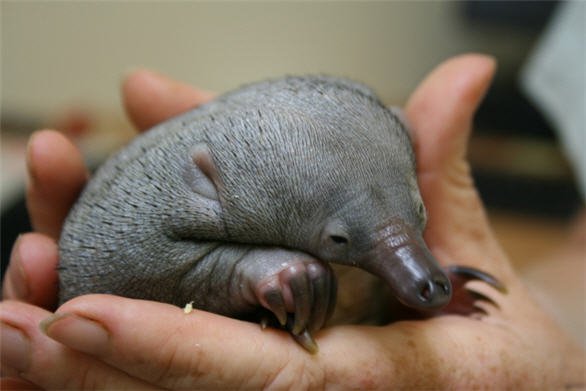
If Myra Jean/now Mira Bee could have anything in the world, it wouldn't be great fame.  She would like a little more wealth, but only so she can carry on as an artist and thinker and all of the other things listed above.  But beyond that, it would make her very happy to have her own baby echidna, the egg-laying mammal that people affectionately call a spiny anteater.  (The fact that something spiny that eats ants is described as such with affection is the key to Mira Bee's universe.)  Mira thinks she looks like one.  But she also thinks her sister looks like one.  She would also be happy with a puggle, spawn of the echidna.


To have a sister is a rare thing, a lifelong source of learning, a songbook, a source of shtick, of codes and private references and gags and secrets and dreams.  Her older sister is always dreaming that the two girls are going somewhere--last week it was on a rowboat to India--and that she has to protect the younger one from harm. And yet having a younger sister--this particular younger sister--saved the older one's life.

Happy birthday, Mira Bee, and happy sister love to all of you so lucky to have one!